 Art
Art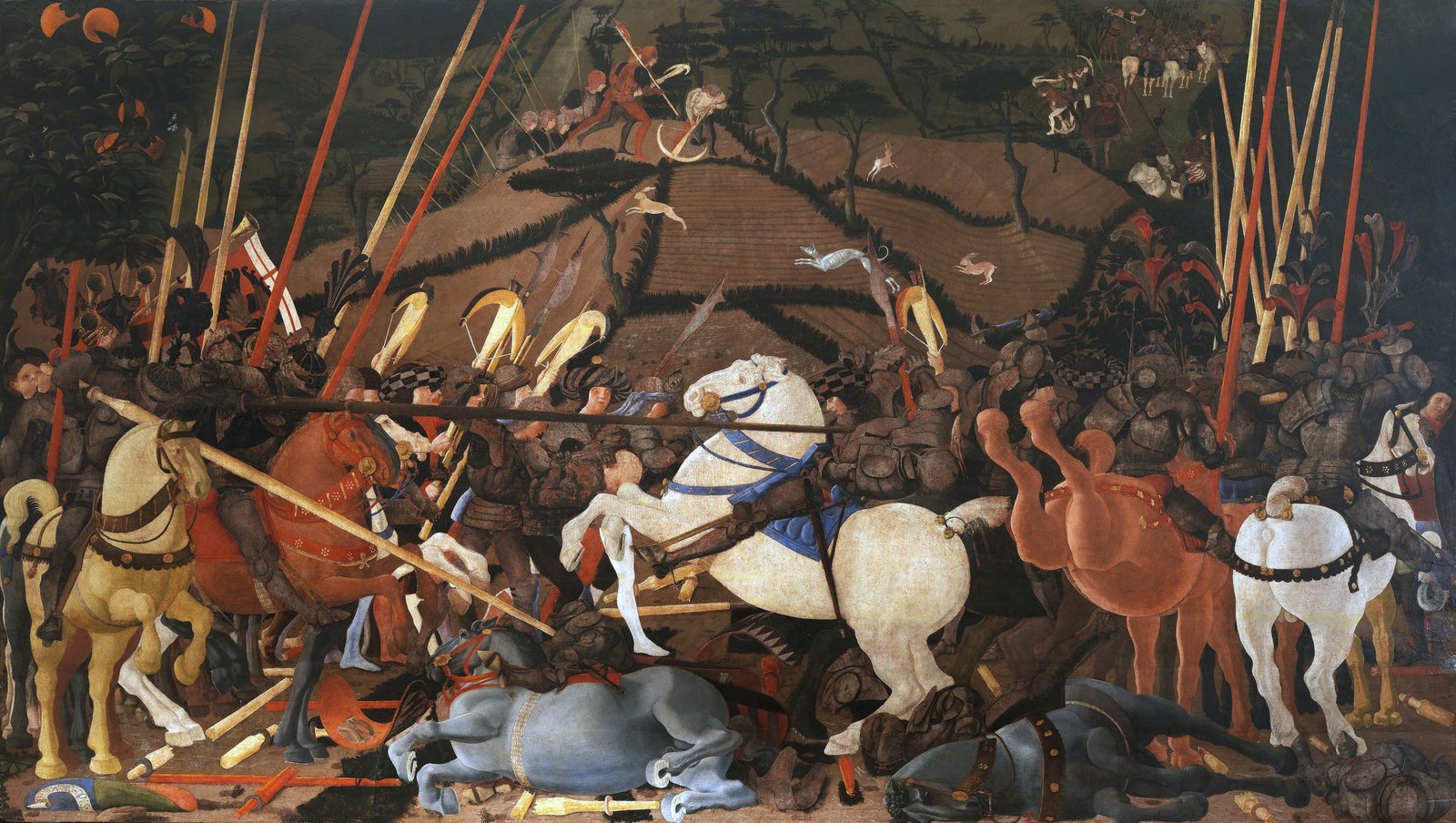
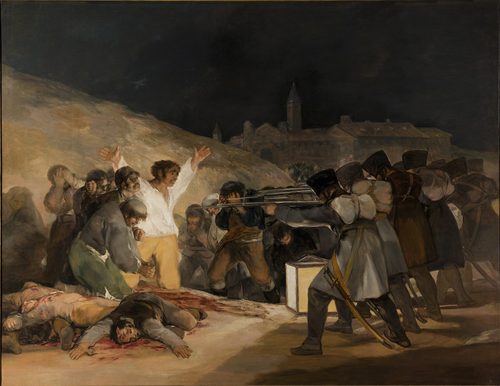
Battle art depicts armed conflict—a cavalry charge, a siege, a naval engagement—as its central subject, painted to commemorate a victory, honor participants, or occasionally condemn war itself. Rulers and generals commissioned the genre to record their triumphs for posterity, turning chaotic, fast-moving combat into a single legible composition with a clear hero and a clear outcome. Because actual battle is confusion, dust, and noise, painters developed conventions to make it readable: raised vantage points, a focal commander on horseback, diagonal sweeps of movement carrying the eye across the field. The genre ranked below history painting in strict academic terms but overlapped with it heavily, since battles were often the climactic scenes within grander historical narratives. Battle art could serve very different purposes depending on patron and era—triumphant record under a court, somber testimony after a national catastrophe—and that tension between glorification and documentation runs through the genre from ancient relief carving to modern war art.
The rules of the genre
The Commander's Pose
A central figure, usually mounted on horseback, gestures forward or points a sword toward the enemy, calm and composed amid surrounding chaos, marking the leader whose decisions the whole composition visually organizes itself around.
Raised Vantage Point
The scene is often shown from a slight height, letting the viewer read troop formations and the shape of the battlefield the way a general would, rather than from ground-level confusion.
Diagonal Momentum
Charging cavalry, streaming banners, and angled lance lines sweep across the canvas on a strong diagonal, giving an otherwise static, frozen image the feeling of forward motion, speed, and irreversible momentum.
Smoke and Dust
Cannon smoke or churned dust fills the middle and far background, obscuring distant action and giving painters a soft, atmospheric way to suggest a battle's true scale without rendering every combatant in explicit detail.
Fallen Foreground Figure
A wounded or fallen soldier often lies in the immediate foreground, grounding the sweeping action in individual human cost and giving the eye a place to pause before the wider scene.
Banners and Uniforms
Flags, uniform colors, and heraldry identify which side is which at a single glance, letting a crowded, chaotic field of anonymous soldiers still read clearly and instantly as two distinct opposing forces.
Symbol decoder
How to read a battle art
- Banner or standard
- → Marks unit identity and rallying point; a fallen or captured standard signals defeat.
- Rearing horse
- → A commander's mount reared on hind legs signals authority, bravery, and control amid chaos.
- Broken lance or sword
- → The cost and disorder of combat, or a specific soldier's defeat, shown through damaged weaponry.
- Smoke plume
- → Distant cannon fire, marking the battle's scale beyond the foreground action.
- Laurel wreath
- → Victory and honor, often awarded to a commander in the aftermath of battle.
- Drum and trumpet
- → Signals of command, rallying troops or announcing a charge across the noise of combat.
The story
Battle art is as old as organized warfare—Egyptian relief carving and Assyrian palace friezes already recorded royal military triumphs in stone. As an independent European genre it matured during the Renaissance, when court painters staged elaborate multi-figure combat scenes to commemorate specific historical victories. Patrons across early modern Europe commissioned battle paintings the way they commissioned portraits, as records of martial legitimacy. The genre gained new urgency in the nineteenth century, when Romantic and academic painters depicted contemporary wars—Napoleonic campaigns above all—sometimes to glorify a leader, sometimes, increasingly, to depict suffering and chaos rather than triumph. Official war artist programs in the twentieth century's world wars pushed the genre further toward documentation, with painters sent to the front to record combat directly rather than reconstruct it from a patron's account, shifting battle art from a commemorative tool toward historical witness.
Masterpieces of the genre
| Work | Artist | Date | Why it matters |
|---|---|---|---|
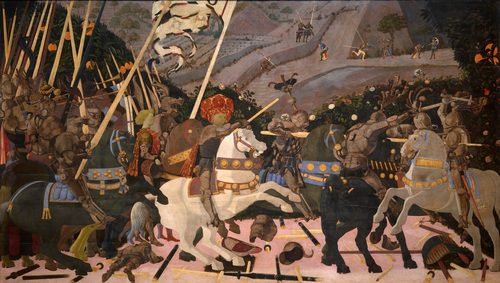
| The Battle of San Romano | Paolo Uccello | c. 1438–40 | A three-panel study in perspective, lances arranged like a geometric grid across the battlefield. |
| Napoleon Crossing the Alps | Jacques-Louis David | 1801 | A commissioned image of triumphant command, the general calm atop a rearing horse. |
| The Third of May 1808 | Francisco Goya | 1814 | An execution rather than a battle proper, but the genre's starkest indictment of war's brutality. |
| Guernica | Pablo Picasso | 1937 | A modernist response to the bombing of a Basque town, battle art turned into anguished abstraction. |
| Washington Crossing the Delaware | Emanuel Leutze | 1851 | A commander leads troops across an icy river in a composition built for national myth-making. |
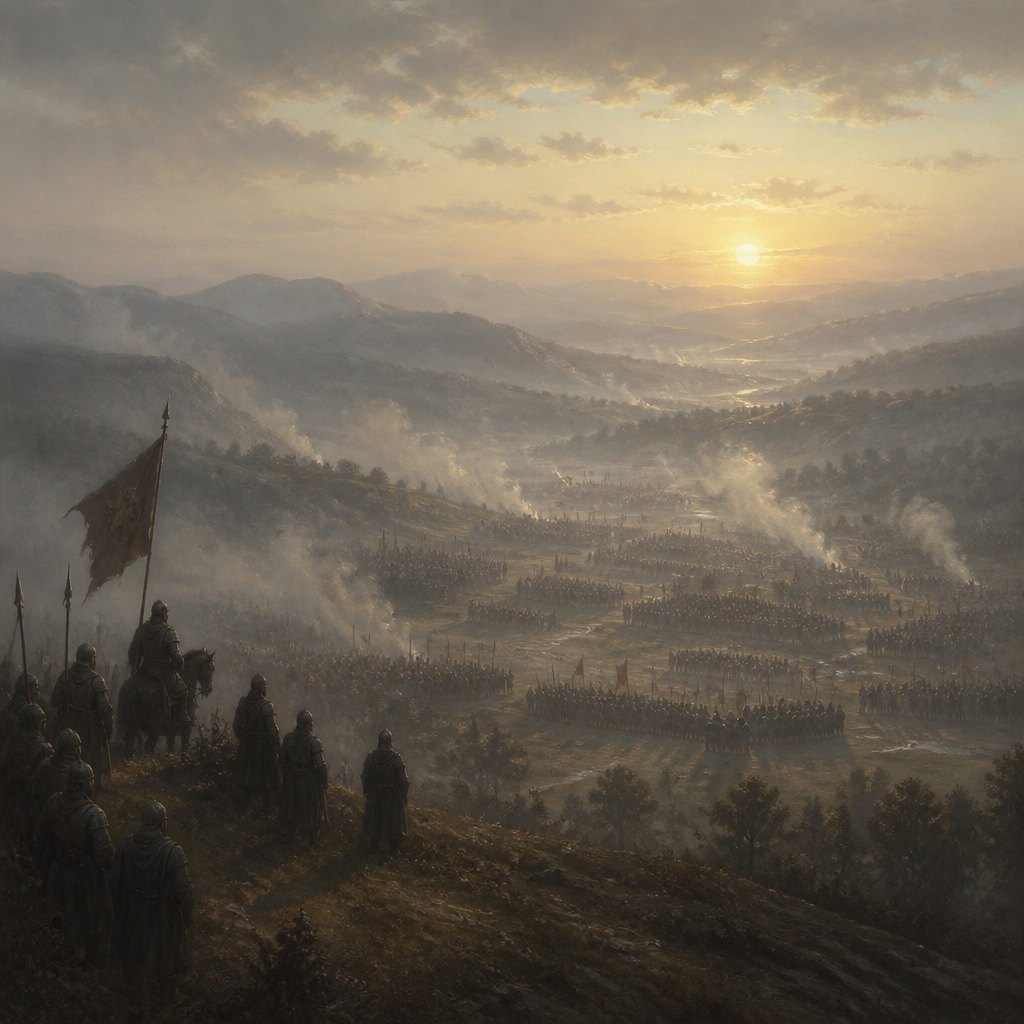 AI-generated
Paint your own
Hang your own battle art in the salon
This example was generated from a prompt like: “An imagined medieval battlefield seen from a hilltop at dawn, distant columns of soldiers and banners advancing through drifting smoke across a misty valley, no close combat visible, muted earth tones and pale gold light.”
Open the Battle Scene Painting Style generator →The genre today
Battle art's conventions now live mostly in film and games: sweeping aerial shots of opposing lines, a commander framed against chaos, smoke and banners marking scale, all descend directly from painted battle scenes. War photography and photojournalism inherited the genre's documentary half, while historical epics and strategy games inherited its choreography. AI image generation renders the atmosphere—dust, motion, banners—convincingly, though it struggles with the specific historical accuracy that gave the genre its original commemorative purpose.
Compose your own
Set your scene at a slight distance and elevation, so the battlefield reads as a whole rather than close combat. Fill the middle distance with columns of soldiers, banners, and rearing horses arranged along a strong diagonal to suggest advancing momentum. Use smoke, dust, or mist to soften the far background and avoid rendering explicit violence—let atmosphere imply danger instead of showing it directly. Anchor the composition with one clear commander figure, mounted and gesturing forward, positioned slightly off-center. Favor a muted, earthy palette cut through with one bright banner color, and keep the sky heavy and dramatic to reinforce the scene's tension.
Frequently asked questions
What is battle art?
Battle art depicts armed conflict—cavalry charges, sieges, or naval combat—as its main subject, historically commissioned to commemorate victories, honor commanders, or, especially from the 1800s onward, document war's real cost.
Why do battle paintings show a raised viewpoint?
A raised vantage lets painters organize chaotic combat into a legible composition, showing troop formations and the shape of the battlefield the way a commanding officer would see it.
Is battle art the same as history painting?
Battle scenes often appear within history painting, but battle art is narrower—focused specifically on armed conflict, while history painting covers any significant historical event, military or otherwise.
How did battle art change in the twentieth century?
Official war artist programs sent painters to the front lines during the world wars, shifting the genre from reconstructed, commemorative scenes toward firsthand documentation of combat's chaos and cost.