 Art
ArtA concept art piece is a design drawing made to visualize something that doesn't yet exist — a character, creature, vehicle, or environment — before it is filmed, animated, built, or coded. It functions as a working tool rather than a finished statement: its job is to answer practical questions, like what a spaceship's cockpit looks like from the pilot's seat, or how a fantasy city reads in fog at dusk. Film studios, game developers, and animation houses commission concept art in bulk, because it's far cheaper to explore ten versions of a costume on paper than to build ten costumes. A single production can generate hundreds of pieces: character turnarounds, prop studies, environment paintings, color scripts mapping a story's emotional arc scene by scene. The genre grew out of older design traditions — theatrical scenery, architectural rendering, and the storyboards of early animation studios — but crystallized as its own field once film and game budgets made pre-visualization essential. Every choice serves a production decision first, beauty second, though the best examples deliver both.
The rules of the genre
Silhouette-First Design
Concept artists block shapes in solid black before adding detail, because a design has to read instantly at a glance — in a dim theater, a loading screen, or a rulebook thumbnail — before color or texture matters at all.
Turnaround Sheets
A character or vehicle gets drawn from front, side, back, and three-quarter angles on one page, so anyone building the design in three dimensions — a sculptor, modeler, or costume shop — has no guesswork left to do.
Mood and Light Studies
Loose, painterly thumbnails establish atmosphere before any hard design begins — a corridor lit by a single flickering bulb, a valley at golden hour — setting the emotional temperature the rest of the production has to match.
Modular Kit-Bashing
Environments and machines get designed as interchangeable parts — armor plates, greebled panels, architectural modules — that can be recombined, scaled, and reused across a whole world, keeping a visual language consistent without repeating a single image.
Color Scripts
A whole story gets reduced to a strip of small, simplified color thumbnails, one per key scene, tracking how light and palette shift from a dark opening to a bright climax — the emotional arc made visible before a single detailed frame exists.
Functional Exaggeration
Shapes get pushed past realism to communicate character instantly — a hero's shoulders widen, a villain's silhouette sharpens into blades and angles — because concept art has seconds, not minutes, to tell an audience who someone is.
Symbol decoder
How to read a concept art
- Silhouette block-in
- → A solid black shape before detail → the design must read instantly, from a distance or at a glance.
- Color script strip
- → A row of tiny thumbnails → the emotional temperature of an entire story, scene by scene, at a glance.
- Greebles
- → Small mechanical clutter added to a surface → signals scale and function, making a spaceship or machine feel real and lived-in.
- Orthographic turnaround
- → Front, side, and back views → this design is meant to be built in three dimensions, not just admired flat.
- Thumbnail sheet
- → A grid of small quick sketches → visible iteration, proof that dozens of ideas were tested before one got chosen.
- Establishing shot painting
- → A wide, detailed environment view → sets scale and mood for a location before a single set gets built.
- Kit-bashed armor
- → Interchangeable panels and plates on a costume or vehicle → a modular design language reused across an entire world.
- Exaggerated silhouette
- → A shape pushed past realism → an instant read on a character's role, hero or villain, without a single line of dialogue.
The story
Concept art's lineage runs through theatrical scene painting, architectural rendering, and the story sketches of early animation studios, but it became a distinct profession in the twentieth century as film and game production grew too expensive to improvise on set. Golden-age Hollywood art departments of the 1930s through 1950s hired illustrators to plan elaborate sets and costumes before construction began; the practice expanded dramatically once science-fiction and fantasy filmmaking demanded entire invented worlds be designed from nothing. Animation studios formalized it further, developing color scripts and turnaround sheets as standard production documents. Video games adopted the discipline wholesale in the 1990s and 2000s, since every asset in an interactive world has to be designed before it can be modeled. Never part of the academic hierarchy of fine art, concept art sat outside gallery culture entirely — commercial, collaborative, and disposable by design — until digital painting tools and online portfolios turned some of its practitioners into recognized artists in their own right.
Masterpieces of the genre
| Work | Artist | Date | Why it matters |
|---|---|---|---|
| Star Wars concept paintings | Ralph McQuarrie | 1975 | Paintings made for a then-nonexistent film helped sell studio executives on the project before a single set existed, setting the visual template for the whole saga. |
| Blade Runner production designs | Syd Mead | 1982 | Mead's 'visual futurist' designs for flying cars and rain-soaked neon streets defined how science fiction imagined future cities for decades afterward. |
| Alien creature and set designs | H.R. Giger | 1979 | Giger's biomechanical creature and environment designs fused machine and organism into one unforgettable image, reshaping horror and science-fiction design alike. |
| Tron costume and vehicle designs | Moebius (Jean Giraud) | 1982 | Moebius brought a European comics sensibility into American studio filmmaking, shaping Tron's costumes and the glowing circuit lines running across them. |
| Star Wars prequel concept art | Doug Chiang | 1995-2002 | As design director on the first two prequel films, Chiang's ships, droids, and cityscapes extended the saga's visual language into a new era of production. |
| Darth Maul character design | Iain McCaig | 1999 | McCaig's paintings developed the villain through many iterations, arriving at the horned head and red-and-black facial markings. |
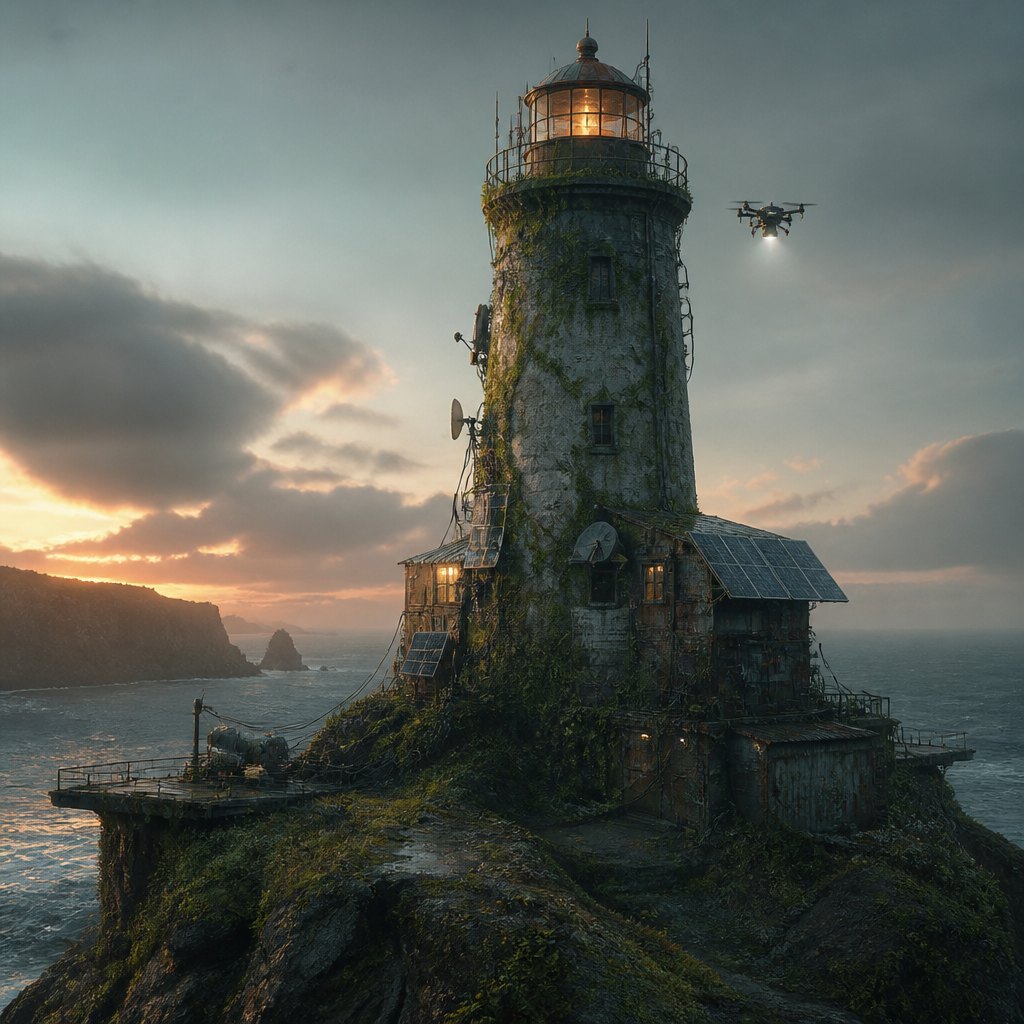 AI-generated
Paint your own
Hang your own concept art in the salon
This example was generated from a prompt like: “Concept art painting of a moss-covered abandoned lighthouse repurposed as a research outpost, cables and solar panels bolted to weathered stone, a small drone hovering near the lantern room at dusk, muted teal and rust palette.”
Open the Concept Art Style generator →The genre today
Concept art now drives nearly every big-budget film, game, and animated series, and it has become a visible career path in its own right, with dedicated software, portfolio sites, and even public exhibitions of production art. Digital painting and 3D blockout tools let artists iterate faster than ever, and AI image generators have entered the pipeline as another exploration tool, generating quick variations for artists to refine, critique, or reject. The core job hasn't changed: making the impossible look inevitable before anyone spends real money building it.
Compose your own
Pick something that doesn't exist yet — a creature, a vehicle, a building, a costume — and design it like it has to survive contact with an engineer or a sculptor. Start with silhouette: block the whole shape in flat, solid tone and check that it reads before you add a single detail. Push proportions past what's comfortable; exaggeration reads faster than accuracy. Once the shape works, generate turnaround views from the front, side, and back, and add functional details — seams, vents, hinges, wear — that explain how the object works rather than just how it looks. Finish with a lighting or mood pass: one strong light source, a limited palette, and a background just developed enough to suggest a whole world beyond the frame.
Frequently asked questions
What is concept art?
Concept art is design work created to visualize a character, creature, vehicle, or environment before it is built, filmed, animated, or coded — a planning tool for film, games, and animation production, not a finished artwork made for its own sake.
Is concept art the same as illustration?
Not quite — illustration usually stands alone as a finished image, while concept art exists to solve a production problem, like what a costume looks like from every angle, and is often discarded once that problem is solved.
Do concept artists get credited on films?
Often, yes, in end credits and dedicated art-of-the-film books, though the work is collaborative by nature — a single design usually passes through many hands before it reaches the screen.
Can concept art be considered fine art?
Some of it is now collected, exhibited, and sold as fine art, especially work by artists who became recognized in their own right, but concept art was originally made to be functional, not decorative.