 Art
Art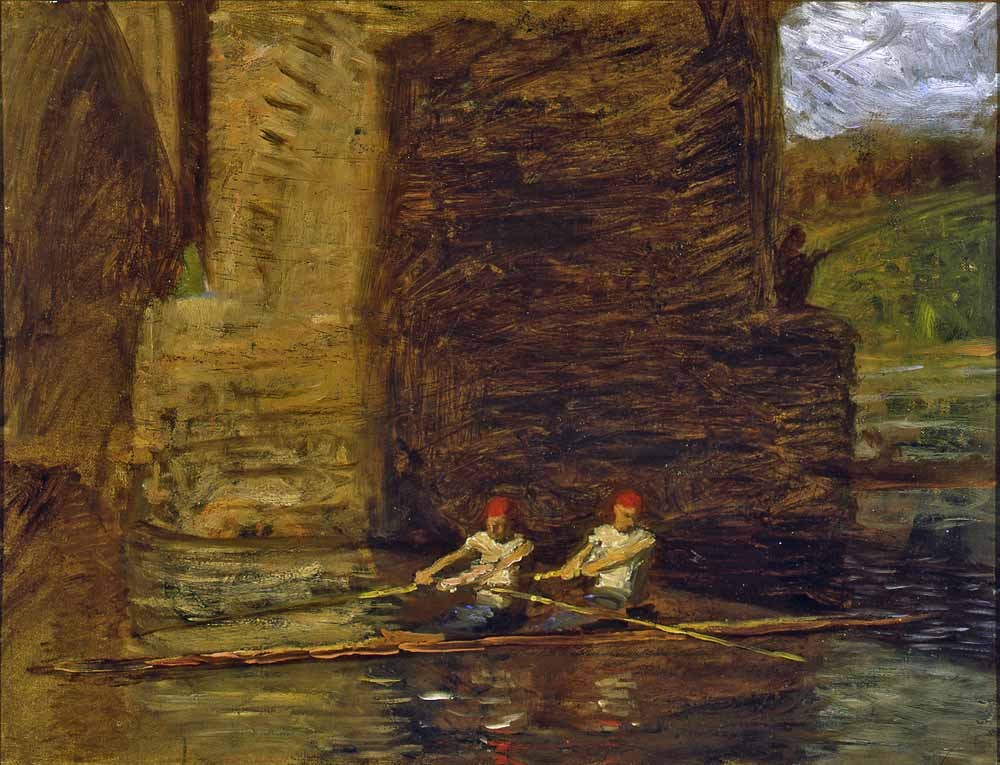
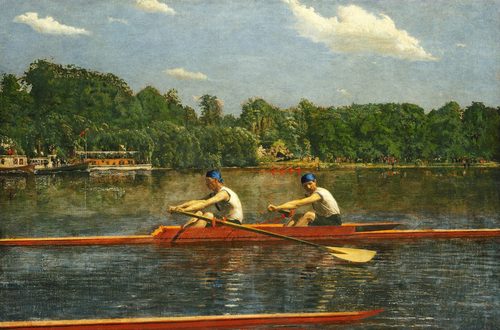
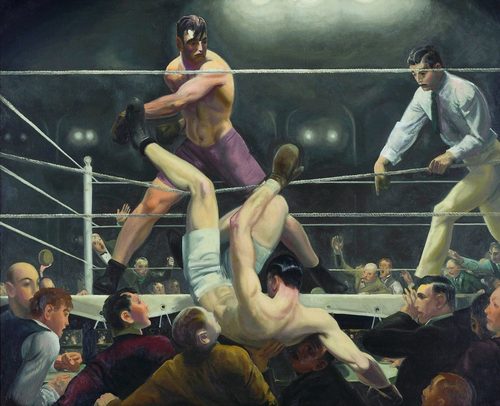
Sports art is any picture built around athletic competition — a foxhunt, a horse race, a boxing match, a baseball diamond — that treats physical contest as worthy of the same formal attention as history or portraiture. It depicts bodies at their most extreme: muscles straining, horses at full gallop, a ball frozen mid-arc, a crowd erupting at the instant of victory. Patrons have always driven the genre. Landed gentry in eighteenth-century Britain commissioned paintings of prize horses and hunting parties to advertise their wealth and breeding stock; nineteenth-century sporting clubs and newspapers wanted images that could be reproduced as prints for a growing public audience; twentieth-century teams, leagues, and broadcasters wanted heroic images of their stars. What unites the genre across centuries is less subject than attitude: sport rendered not as leisure but as spectacle, a stage where ordinary people display extraordinary skill, nerve, or luck in front of an audience that wants to feel the outcome mattered.
The rules of the genre
Peak-Action Freeze
The composition catches a competitor at the single most extreme instant of effort — the top of a jump, the split second before a punch lands — because that frozen peak reads as more dramatic than the motion around it.
The Animal Portrait
Prize horses, hunting dogs, and racing greyhounds get painted with the same individual likeness as a human sitter — a named animal, posed in profile, its conformation and coat rendered as carefully as any patron's face.
The Roaring Crowd
A blurred or distant mass of spectators fills the background, turning a private moment of exertion into public spectacle — the audience's presence is what separates sports art from a plain study of a body in motion.
Diagonal Momentum
Bodies, horses, and boats get angled hard across the canvas rather than posed flat and frontal, a diagonal thrust that reads instantly as speed even when the picture itself is completely still.
Uniform and Colors
Team colors, jockey silks, or club stripes get rendered with almost heraldic precision, since a viewer needs to identify who is winning and which side a figure belongs to at a single glance across a crowded field.
The Triumphant Finish
The scene favors the decisive moment over the ordinary middle of a match — a horse crossing the line, a boxer's raised arm, a boat clearing the buoy — because sports art sells the outcome, not the routine of practice.
Symbol decoder
How to read a sports art
- Laurel wreath
- → A crown of leaves on a victor's head → classical inheritance from ancient Greek athletic games, still used to signal triumph.
- Jockey silks
- → Bright, patterned racing colors → identify ownership and stable, letting a viewer read who is winning without seeing a face.
- Raised arm or fist
- → A single limb thrust skyward at the finish → the universal shorthand for victory, understood without any caption.
- Finish line or tape
- → A taut line stretched across the track → the literal boundary between contest and triumph, the moment a race becomes history.
- Checkered pattern
- → A black-and-white checked flag or border → motor racing's signal that a contest has ended and a winner is fixed.
- Trophy or cup
- → A raised vessel held overhead → the tangible proof of victory, transforming a fleeting moment into a permanent object.
- Foam and spray
- → White water breaking around a hull or oar → visual shorthand for speed and effort in rowing and sailing scenes.
- Dust or turf clods
- → Debris kicked up behind a running horse or athlete → makes velocity visible even in a single still image.
The story
Sports art has roots in ancient Greek vase painting and sculpture, which celebrated athletes at the original Olympic and Panhellenic games as models of civic virtue. The genre as a distinct European tradition took shape in eighteenth-century Britain, where landed patrons commissioned equestrian and hunting scenes to celebrate their estates and prize bloodstock; painters specializing in horses and dogs built entire careers on aristocratic commissions. The nineteenth century widened the audience considerably: cheap prints of horse races, boxing matches, and rowing regattas circulated among a public newly able to bet on and follow organized sport. Academic hierarchies never rated sporting subjects highly, filing them below history painting and portraiture as a form of specialized, almost decorative craft. The twentieth century transformed the genre again, as photography took over documentary duty and painters and illustrators leaned instead into dynamic, expressive, sometimes near-abstract renderings of motion that a camera couldn't quite capture.
Masterpieces of the genre
| Work | Artist | Date | Why it matters |
|---|---|---|---|
| Whistlejacket | George Stubbs | 1762 | A nearly life-size portrait of a rearing racehorse against a bare background, painted with such anatomical precision it became the model for equestrian sporting art. |
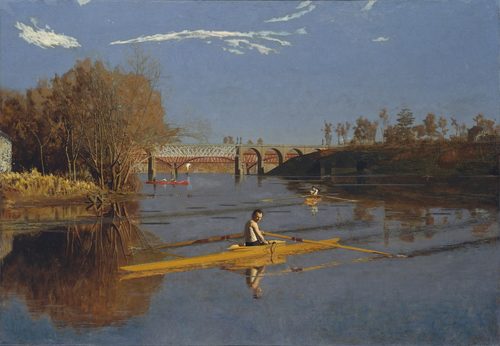
| Max Schmitt in a Single Scull | Thomas Eakins | 1871 | A rower caught mid-race on a glassy river, rendered with near-scientific attention to light and perspective — American sporting art's move toward realism. |
| Racehorses at Longchamp | Edgar Degas | 1871 | One of many racecourse studies by Degas, catching horses and jockeys at odd, off-balance angles in abruptly cropped, asymmetrical framing. |
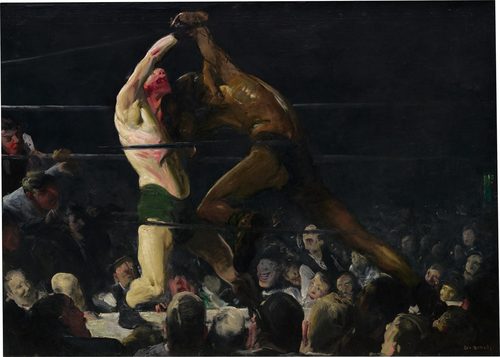
| Stag at Sharkey's | George Bellows | 1909 | Two boxers locked in a violent clinch under a single hanging light, one of the defining images of the sport's disreputable, thrilling early gyms. |
| Dempsey and Firpo | George Bellows | 1924 | A boxer knocked clean through the ropes into the ringside crowd, one of the most kinetic images ever made of a single sporting instant. |
 AI-generated
Paint your own
Hang your own sports art in the salon
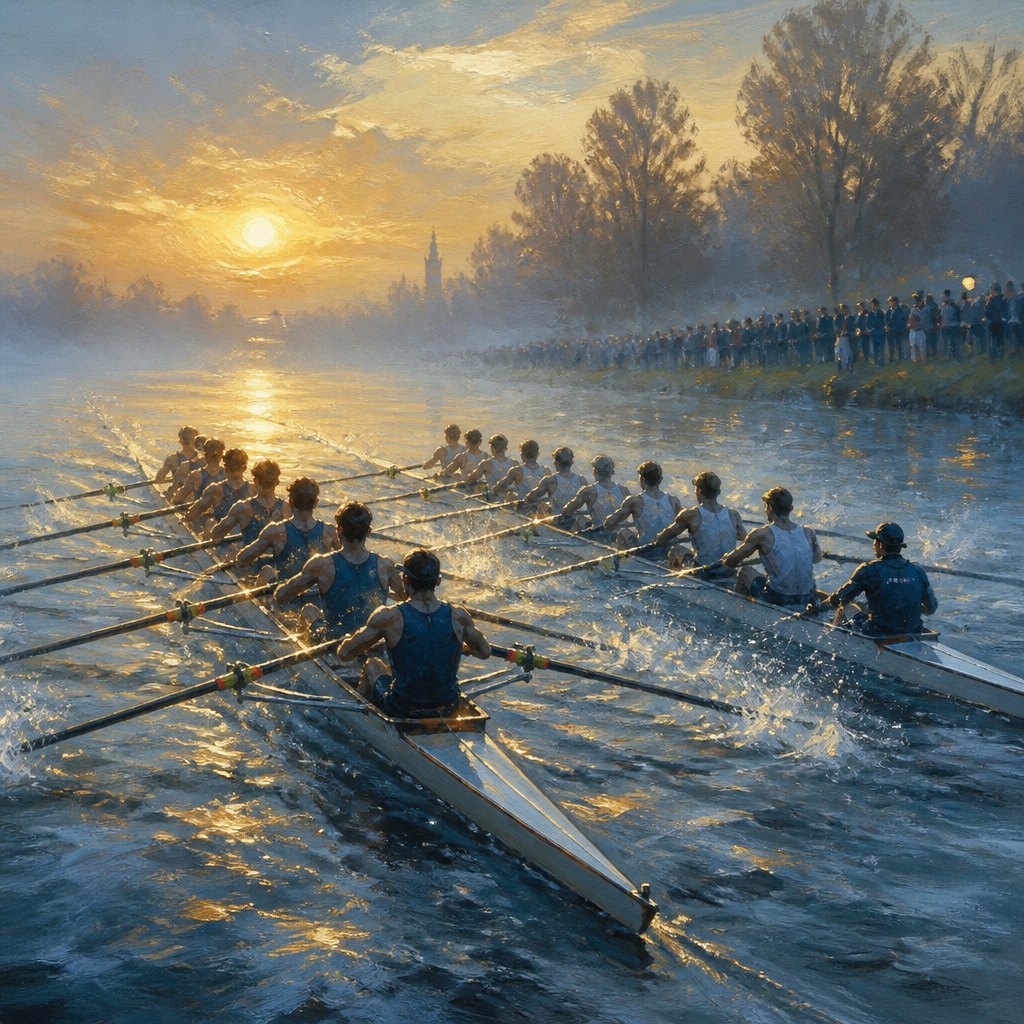
This example was generated from a prompt like: “Sports art painting of two rowing eights racing neck and neck across a misty river at dawn, oars mid-stroke throwing spray, distant spectators blurred along the bank, dynamic diagonal composition in cool blues and gold light.”
Open the Sporting Art Style generator →The genre today
Sports art now lives mostly in editorial illustration, official Olympic and league posters, trading-card art, and stadium murals, while photography and video handle most documentary duty. Painters and illustrators still get commissioned for commemorative prints, championship posters, and athlete portraits that a photograph can't quite deliver — something more heroic or symbolic than a sideline camera captures. AI image generators now produce quick sports-themed illustrations for merchandise and social media, borrowing the genre's old tricks: diagonal motion, peak action, triumphant gesture.
Compose your own
Choose a single decisive instant rather than a whole match — the top of a jump, the split second before contact, the moment a line is crossed. Angle the main figure or vehicle diagonally across the frame to suggest speed even in a still image, and keep the background loose or blurred so it doesn't compete with the subject. Render uniform colors, team stripes, or racing silks with precision, since they carry information a viewer needs to read the scene at a glance. Add a hint of environment — dust kicked up, spray off a hull, a crowd reduced to smears of color — to sell effort and momentum. Finish with strong directional light that rakes across muscle, cloth, or coat to emphasize motion and strain.
Frequently asked questions
What is sports art?
Sports art is any painting, print, or illustration built around athletic competition — races, matches, hunts, or games — that treats physical contest with the same formal seriousness traditionally given to history painting or portraiture.
Why did people commission sports art?
In eighteenth-century Britain, landowners commissioned paintings of prize horses and hunts to advertise wealth and bloodstock; later, clubs, newspapers, and fans wanted images of races and matches they could own or display.
How is sports art different from a sports photograph?
A photograph documents what actually happened; sports art can idealize, exaggerate, or compress a moment for maximum drama, choosing the single most heroic angle even if it never looked quite that way.
Is sports art still made today?
Yes — in commemorative posters, trading-card illustration, stadium murals, and editorial art, though photography and video now handle most of the documentary work sports painting once did.